Caravan Type Approval

Put your caravan projects on the road with confidence.

Caravan manufacturing involves much more than design and production. Technical compliance, type approval, documentation and manufacturing processes must be considered together. Anemon Engineering provides end-to-end homologation support for caravan manufacturers and vehicle converters.

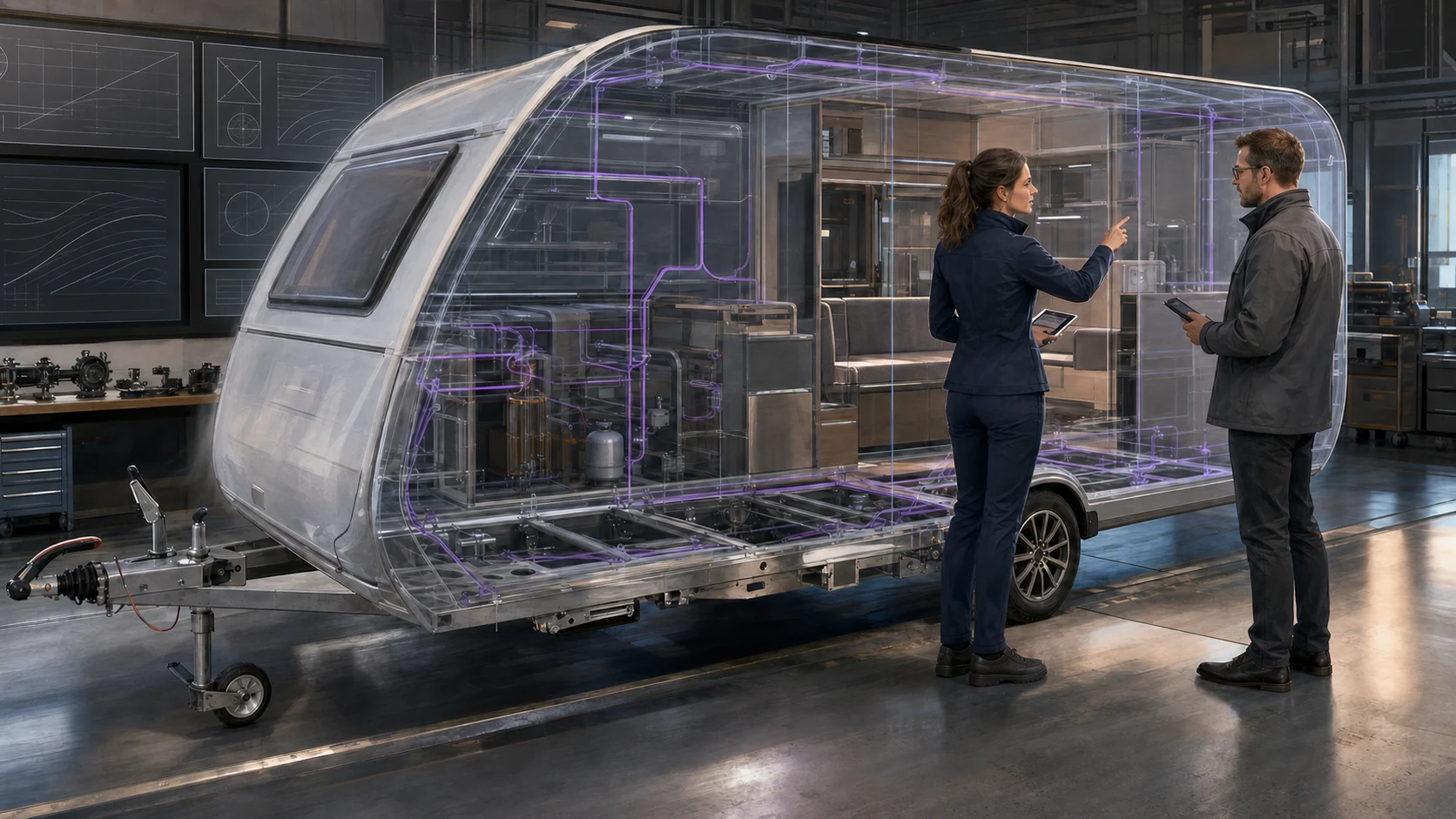
Technical assessment environment for motor caravan and trailer caravan type approval

Caravans differ from conventional vehicle projects.

A caravan project is not simply a living space added to a vehicle body or chassis. Whether the project involves a motor caravan, trailer caravan, O1 or O2 vehicle, or another special-purpose configuration, interior systems, equipment mountings, mass distribution, intended use and manufacturing repeatability must be assessed as one technical system.

The interior layout, furniture, electrical installation, water system, gas appliances, ventilation and auxiliary equipment all alter the vehicle’s technical characteristics. These changes can directly affect vehicle category, mass values, safety requirements, documentation and the approval strategy.

Caravan homologation is therefore not a matter of submitting documents at the end of production. The sound approach is to establish the project’s technical boundaries before manufacturing begins, select the appropriate approval route and create documentation that the manufacturer can maintain in practice.


Experience across different caravan projects.

Motor Caravan Projects

For motor caravans, the base vehicle’s technical limits, interior layout, mounting solutions, mass distribution and special-purpose-vehicle requirements must be assessed together. Design decisions need to align with the technical file and approval strategy from the outset.

Trailer Caravan Projects

For trailer caravans, the chassis, body, axle, coupling components, braking system and mass values form the technical foundation. Correctly determining whether the product falls within O1 or O2 directly affects the application scope and production preparation.

O1 Caravan Projects

O1 projects require careful control of the low-mass target, chassis structure, body materials and equipment selection. Even seemingly minor equipment changes can affect mass, balance and the technical file.

O2 Caravan Projects

O2 projects require more extensive assessment of the braking system, axle arrangement, coupling components and maximum mass. The manufacturer should define the product scope and variants before production begins.

Special-Purpose Caravans

In caravans designed for a particular use, interior systems, equipment layout, energy infrastructure and operating scenario may produce technical consequences that differ from those of a standard product. Each project must be assessed in its own context.

Caravan Conversion Projects

For conversions, the existing vehicle’s technical characteristics, the extent of the modification and the new intended use must be considered together. A poorly defined starting point can lead to substantial revisions after the build is complete.

Frequent issues that make caravan projects more difficult.

Mass Management

Interior equipment, furniture, water tanks, energy systems and auxiliary installations can increase total mass quickly. Mass distribution and regulatory limits should be monitored from the earliest design stage.

Layout Planning

Interior layout is not only an ergonomic matter. Mounting points, escape areas, load distribution, equipment access and the location of technical systems all affect the compliance assessment.

Technical Documentation

Incomplete drawings, product descriptions, component information, calculations or variant records increase the need for explanations and revisions during the application.

Electrical Systems

Batteries, inverters, charging units, lighting, sockets and auxiliary electrical systems must be clearly defined in terms of safety, installation and documentation.

Gas Systems

Where gas appliances are fitted, system components, layout, connections and the safety approach must be presented clearly in the technical file.

Water Systems

Fresh-water and waste-water systems, tank locations and connections must be assessed for both mass implications and installation quality.

Vehicle-Category Determination

The distinction between a motor caravan, trailer caravan, O1, O2 or another special-purpose vehicle changes the approval route. An incorrect category decision can affect the entire structure of the technical file.

Type-Approval Planning

EU type approval, national type approval, series production or series conversion must be selected according to the target market, production volume and project model.

Sound planning creates more predictable projects.

Vehicle-Platform Selection

The choice of base vehicle or chassis determines payload capacity, layout flexibility, equipment scope and the available approval route. The platform should be selected for technical suitability, not commercial availability alone.

Technical Requirements

Vehicle category, mass, braking system, coupling components, equipment layout and safety requirements should be defined at the beginning of the project. Starting production before these points are clear increases the risk of later revisions.

Design Assessment

Interior architecture and product design are more sustainable when developed in line with technical requirements. Manufacturability, mounting points and the relationship with technical systems should be reviewed together.

Production Model

One-off, low-volume and series production may each require a different approval route and document set. Defining the production model early makes it possible to establish the correct approval strategy.

Documentation Structure

The technical file supports not only the application, but also the manufacturer’s retained knowledge and management of future variants. Drawings, lists, descriptions and evidence must remain traceable.

Conformity of Production

COP preparation supports the repeatable manufacture of the same product to the same technical standard. Production controls should be designed from the outset to maintain continuity after approval.

Traceability of chassis attachments, mass distribution, gas installation and electrical systems in a caravan technical dossier

The work behind every successful project.

In caravan type approval, the technical file is the project’s technical memory. It brings together interior-layout drawings, the relationship with the chassis or base vehicle, equipment lists, mass data, mounting details, descriptions of electrical and auxiliary systems, product variants and supporting evidence.

A robust technical file enables the assessment body to understand the project clearly. For the manufacturer, it also shows how later units should be reproduced, which variants must remain controlled and which technical decisions require formal change management.

Anemon Engineering treats the technical file not merely as application paperwork, but as a core management tool for product development, conformity of production and post-approval continuity.

End-to-end support for caravan projects.

01

Preliminary Project Assessment

The product concept, vehicle type, target market, production volume and current technical decisions are reviewed together. This establishes which approval route is most appropriate for the project.

02

Vehicle-Category Analysis

Motor caravan, trailer caravan, O1, O2, M1 and special-purpose classifications are assessed for the specific project. Category analysis defines the foundation of the technical file and application strategy.

03

Type-Approval Strategy

EU type approval, national type approval, series production, series conversion and project-specific routes are aligned with the manufacturer’s commercial and production objectives.

04

Technical-Document Management

Drawings, descriptions, equipment lists, calculations, component information and supporting evidence are organised for the application process.

05

Process Planning

Technical decisions, documentation, application preparation, assessment stages and possible revisions are brought together in a practical schedule.

06

Application Management

The application file, authority communications, requests for clarification and process follow-up are managed systematically, allowing the manufacturer to proceed with clear technical decisions.

07

Conformity-of-Production Preparation

Manufacturing repeatability, record systems, variant management and quality-control arrangements are assessed to maintain continuity after approval.

08

Post-Certification Support

Technical continuity is maintained for new variants, product updates, production changes and subsequent applications.

Every caravan project has its own requirements.

Experience in caravan projects means more than having submitted previous applications. Different layouts, base vehicles, chassis solutions, equipment packages and production models can lead to different technical outcomes even under the same approval route.

A low-volume trailer caravan project cannot be managed in the same way as a motor caravan programme intended for series production. Mass and braking may dominate one project, while interior-system layout, documentation discipline or conformity of production may be more decisive in another.

Anemon Engineering helps identify these distinctions early so manufacturers can make project decisions with greater control. This allows the approval process to be designed correctly from the outset rather than repaired after production.

Supporting different participants across the caravan sector.

Caravan Manufacturers

For series and low-volume manufacturers, product architecture, the technical file, type-approval strategy and conformity of production are planned together.

Vehicle Converters

For companies converting base vehicles into motor caravans, the modification scope, interior layout, mass and technical documentation are assessed for the individual project.

Special-Purpose Vehicle Manufacturers

Where a project combines caravan accommodation with other operating purposes, vehicle category, system integration and application scope require careful assessment.

New Manufacturers

For new manufacturers, understanding the technical requirements and approval route early supports better-controlled investment and production decisions.

Importers

For importers planning local production or assembly, the target market, product compliance, technical documentation and approval route are assessed from the outset.

Low-Volume Manufacturers

For low-volume production, we establish a practical and sustainable homologation approach with a clearly defined scope.

Structuring the process step by step.

01Initial Assessment

The project concept, vehicle type, target market, production volume and existing technical decisions are reviewed during the first consultation.

02Technical Analysis

Vehicle category, mass, layout, systems, relationship with the chassis or base vehicle and key technical risks are analysed.

03Documentation Planning

A roadmap is prepared for the technical file, drawings, equipment lists, calculations and supporting evidence.

04Application Preparation

The application file and information set are prepared for the selected approval strategy, and outstanding items are completed with the manufacturer.

05Process Management

Technical questions, requests for clarification, revisions and authority communications are followed through in a planned manner.

06Production and Beyond

After approval, conformity of production, variant management and technical continuity for new projects remain supported.

What you need to know about caravan type approval.

Vehicle category, production model, technical file and target market must be assessed together. Each caravan project therefore requires its own technical context.

Caravan type approval is the certification process in which the vehicle category, technical configuration, safety requirements, documentation and conformity-of-production arrangements are assessed. It involves more than submitting an application; the product itself must be developed on a sound technical basis.

The process begins with an analysis of the project scope. Vehicle category, choice of base vehicle or chassis, layout, mass, technical systems, supporting evidence and application strategy are assessed together.

For motor caravans, the base vehicle’s technical limits, interior layout, equipment mountings, electrical and water systems, mass effects and special-purpose classification are considered together. Planning should begin during design, not after it is complete.

Yes. Support can cover O1 or O2 classification, chassis and body construction, braking systems, coupling components, mass data, technical documentation and conformity of production.

Yes. O1 and O2 projects may require different assessments of maximum mass, braking systems, technical equipment, application scope and production planning. The category should therefore be confirmed at the earliest stage.

Yes. For new caravan manufacturers, early understanding of the technical requirements and approval route is especially important. Anemon Engineering supports product architecture, the production model, technical documentation and application strategy.

Through drawings, product descriptions, component data, calculations, system details and supporting evidence, the technical file demonstrates the project’s technical consistency. A strong file makes the process clearer and more traceable.

Conformity of production ensures that the approved technical configuration is preserved in later units. For caravan manufacturers, maintaining the same quality and technical standard after certification is as important as the initial application.

Yes. Base-vehicle selection, modification scope, interior layout, mass distribution, equipment mountings, technical drawings and the application route can all be assessed for the specific conversion.

Planning should begin before manufacturing or conversion starts. Waiting until the interior layout, equipment and chassis decisions are fixed increases the risk of technical revisions.

Anemon Engineering provides preliminary project assessment, category analysis, type-approval strategy, technical documentation, application management, conformity-of-production preparation and post-certification support.

The decision should reflect the target market, production volume, vehicle category, product variants and the manufacturer’s commercial plan. The same approval route is not appropriate for every caravan project.

A dependable technical partner for caravan projects.

For caravan manufacturers, homologation cannot be separated from product design, production planning or certification objectives. If technical requirements are considered too late, completed products may require design changes, mass revisions, additional documentation or delayed applications.

Anemon Engineering combines sector knowledge, engineering judgement and process management for caravan manufacturers, conversion companies, special-purpose vehicle manufacturers, start-ups and low-volume producers. Our objective is not simply to prepare an application, but to establish a technically sustainable and traceable product that reflects manufacturing reality.

Let us assess your caravan project.

Together, we can plan the technical support required for caravan manufacturing, conversion projects and type approval.